Flat Roof Repair
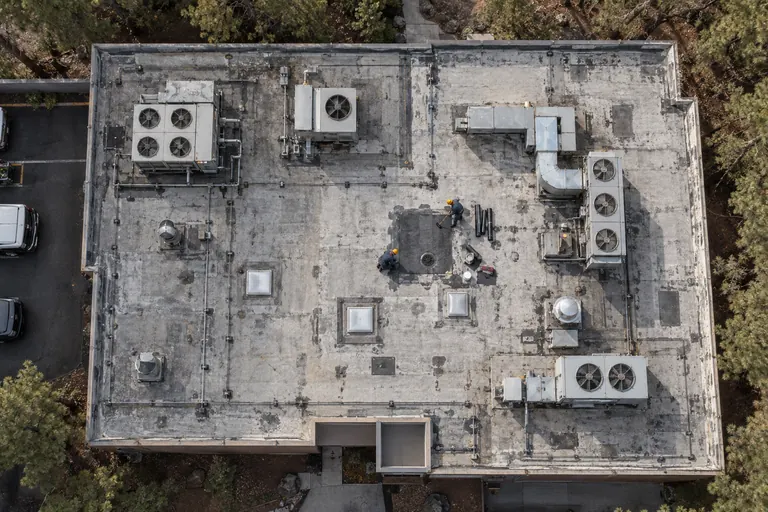
Most traced leaks on low-slope roofs end at a seam, curb, or drain, which flat roof repair fixes with matching membrane.
Flat roof repair in Flagstaff
Commercial roof leak repair in Flagstaff that starts at the stain, traces the water back to its opening on the roof, then fixes that detail and rechecks it.
Most leaks come from one failed detail. A few point to a roof that needs more.
Water travels before it drips. These are the five places a trace most often leads back to on Flagstaff roofs.
A stain near the low side of a bay often starts at a seam several feet upslope. Water runs between the membrane and insulation until it finds a deck joint to drop through.
Corners of rooftop unit curbs open first because flashing is folded there. Water entering at a corner can follow the curb framing and drip far from the unit.
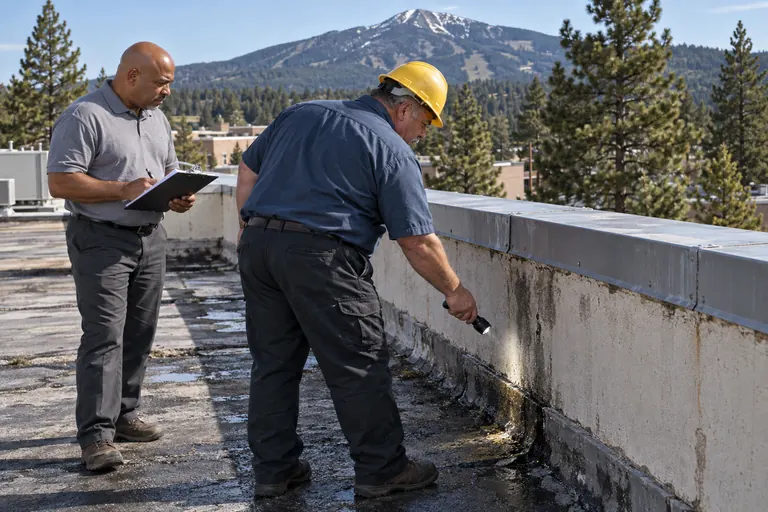
Cracked counterflashing lets water behind the membrane at walls and parapets. It then runs along the base of the wall and shows up as a stain along an interior wall line.
Water reaching a pipe or conduit penetration often travels down it and drips at a fitting below. Split boots and dried pitch pans are checked wherever a stain sits near piping.
Loose clamping rings let water under the membrane right at the drain, where it follows the drain line down. Stains around a drain leader inside point here.
Some leak work slows the water now. The rest fixes the opening for good.
| Repair | What It Does | When |
|---|---|---|
| Seam tape | Short-term seal on a split seam | Stopgap until a dry day |
| Weighted patch or tarp | Covers a torn area during storms | Stopgap, inspected after weather |
| Drain clearing | Stops water backing up under laps | First relief, then a drain reset |
| Permanent repair | Rebuilds the failed seam, flashing, or boot | Once the area is dry and confirmed |
A leak patched in the wrong place keeps coming back. Tracing it first protects these.
Patching the first opening you see often misses the real one. A traced leak gets fixed once, at the detail that actually let water in.
Every week a leak runs, water spreads farther across the insulation. Finding the source early keeps the wet area, and the repair, smaller.
Offices, storage bays, and production floors under a leak lose space to buckets and tarps. A confirmed repair lets that space go back to work.
Photos of the traced path and the repaired roof detail stay with the building records, which helps the next inspection and any insurance question.
Call and describe where it is and when it grows. We can set up a temporary fix while the trace is planned.
Leak work splits between the room with the stain and the roof above it.
The roof above the stain is walked first, then everything upslope of it: seams, curbs, walls, drains, and penetrations, with photos and moisture readings at each suspect spot.
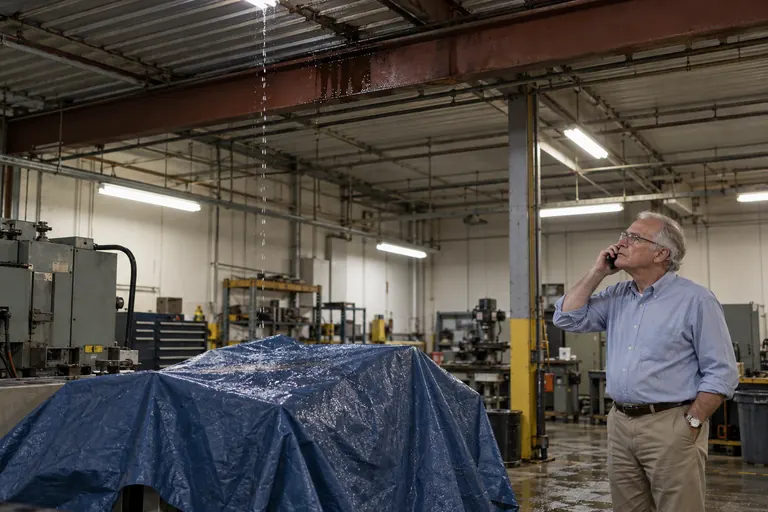
Inside, the stain, any drip points, and wet materials are measured from walls and columns so they can be located on the roof plan above.
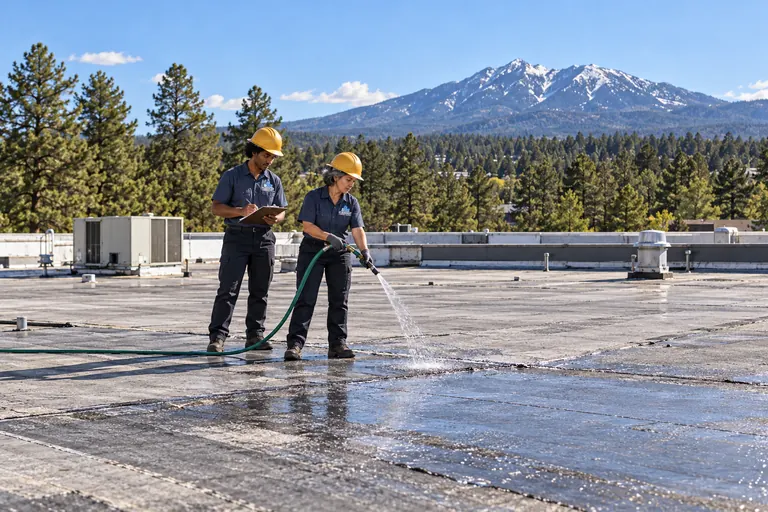
A controlled water test runs on one seam or curb at a time while someone watches inside, so the entry point is confirmed instead of guessed.
The confirmed detail is repaired: a seam rewelded or retaped, flashing rebuilt, a boot replaced, or a drain reset, with wet insulation removed around it.
After the next storm or thaw, the room below is checked again. A dry ceiling closes the job; a new stain starts a fresh trace from where it appears.
The opening a trace finds usually belongs to one of these.
Most traced leaks on low-slope roofs end at a seam, curb, or drain, which flat roof repair fixes with matching membrane.
Flat roof repair in Flagstaff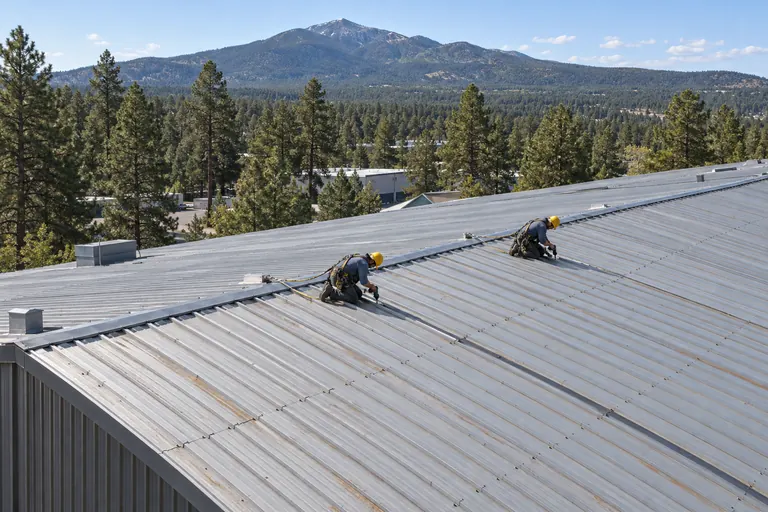
On panel roofs the trail usually ends at a loose fastener or a dried lap, the core of metal roof repair.
Commercial metal roof repairAnswers about tracing, stopgaps, and lasting leak repairs.
Because water travels before it drips. It runs along deck flutes, across the tops of insulation boards, or down pipes and conduit, so the stain can sit many feet from the opening. Tracing starts at the stain, works upslope, and uses moisture readings or a water test to confirm the path.
Often. An infrared scan taken after sunset shows wet insulation holding heat longer than dry areas, which maps where water has spread. It narrows the search, and core cuts or a water test confirm the exact opening.
Wind direction and meltwater explain most of it. Rain driven from one side reaches flashing that stays dry in calm storms, and snow piled against a wall melts into openings that rain never reaches.
Only if it is checked. Tape and weighted patches wear out quickly in freeze-thaw, so they get looked at after each storm and replaced by the permanent repair at the first dry, mild stretch.
Yes, if it can be moved safely. Cover what stays with plastic, put a bucket under the drip, and photograph the stain and anything damaged before cleanup. Those photos help both the trace and any insurance claim.
We do. On panel roofs, water often runs along a purlin or the panel rib before dripping, so the trace follows the fastener lines and laps upslope from the drip.
It depends on how long the trace takes, how much wet insulation must be replaced, and the roof system. A single failed boot costs far less than a seam with soaked boards around it. The inspection gives you the repair list before work begins.
Tell us where the stain is and when it shows up. The trace starts from there.